AI Cyber Risk

72%
Of employees already use AI tools at work — most without IT approval
"Shadow AI is the fastest-growing source of unmanaged risk in public sector organizations — and most IT teams have no visibility into which tools are in use."
Source: Microsoft Work Trend Index 2024

3 in 4
AI-enabled software vendors share data with third parties by default
"The AI features embedded in the tools your district or agency already uses may be processing sensitive data in ways that were never reviewed or approved."
Source: Common Sense Media AI in Education Privacy Report 2024
89%
Of public entities have no formal AI governance policy
"AI risk cannot be managed without visibility. Most public entities have neither — creating exposure to FERPA, HIPAA, and CJIS violations they may not even be aware of."
Source: NASCIO / IBM State & Local Government AI Governance Survey 2024

Shadow AI Use
Staff may begin using AI tools informally, without approval, security review, or data handling guidance. Generative AI tools, browser plugins, and third-party assistants are already in use at most public entities — whether IT knows or not.

Sensitive Data Exposure
Confidential student, employee, legal, financial, or operational data may be entered into AI systems without appropriate safeguards. Once data is submitted to an AI platform, retrieval and deletion rights depend entirely on the vendor's policies.

AI-Enabled Software Risk
Organizations may not fully understand how AI features embedded in vendor software process, retain, or use their data. Many common education and government platforms now incorporate AI features that were not present when contracts were signed.
Governance Gaps
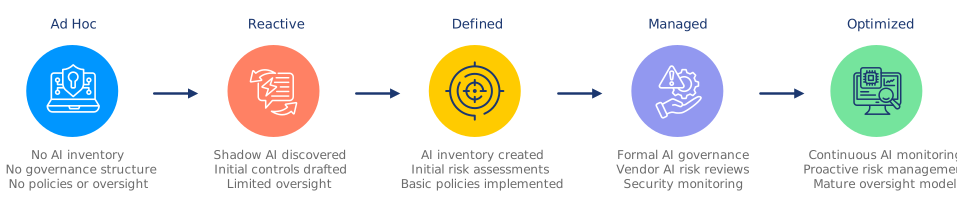
Many public entities do not yet have policies, approval workflows, or oversight structures for responsible AI use. Without clear governance, staff have no guidance — and leadership has no visibility into how AI is affecting operations and risk.

Integration Vulnerabilities
AI systems connected to internal data sources or operational systems can introduce cybersecurity weaknesses if not properly reviewed. APIs, automated workflows, and data connectors are common attack surfaces that AI integrations can expand.

Limited Ongoing Oversight
Without structured monitoring and reporting, organizations may struggle to track new AI use cases or unresolved risk over time. The AI risk landscape changes rapidly — a one-time review without ongoing oversight quickly becomes outdated.

AI Exposure Discovery
Where AI tools and AI-enabled software may be in use across the organization is identified — including third-party platforms, vendor integrations, and internal initiatives. The result is an AI usage inventory that most public entities do not currently have.

AI Cybersecurity Risk Review
Potential vulnerabilities associated with AI systems, integrations, workflows, and internal or vendor-supported AI capabilities are evaluated. Risk findings are mapped to recognized frameworks including NIST AI RMF and NIST CSF.

Data Exposure & Privacy Review
Whether sensitive information could be exposed through prompts, uploads, integrations, or AI-supported business processes is assessed — across FERPA, HIPAA, CJIS, and state privacy requirements.
Governance & Policy Evaluation
Your organization's policies, oversight processes, and accountability structures for responsible AI use are reviewed. Gaps between current practices and recognized governance standards are identified and documented.
Vendor AI Risk Review
How AI vendors address security, data protection, retention, and operational risk in the products your organization uses is evaluated. Vendor data practices are compared against contract obligations and applicable regulatory requirements.

Risk Mitigation Roadmap
Clear next steps to help leadership strengthen governance, reduce vulnerabilities, and improve ongoing oversight are delivered. The roadmap prioritizes actions by risk level and implementation feasibility.

Built for Public Sector AI Governance Realities
AI governance in schools and public agencies is fundamentally different from enterprise AI risk. FERPA, HIPAA, CJIS, state student data privacy laws, and public records considerations are central — not afterthoughts. The assessment is designed around these requirements from the ground up.

Lower Your Insurance Costs
Cyber insurers are beginning to ask about AI governance — specifically whether policies exist and whether vendor data practices have been reviewed. A documented AI risk assessment provides the evidence insurers require and positions your organization for lower premiums.

Practical Recommendations Your Team Can Actually Implement
Assessment findings are translated into recommendations that reflect the staffing, budget, and operational realities of public-sector organizations. Every recommendation includes an implementation priority and difficulty rating — not just a list of ideal controls.

Vulnerability Scanning
Continuously identify security gaps across your systems before attackers can exploit them.
Cyber Tabletop Exercises
Test your team's incident response with scenario-based exercises that reveal gaps before a real attack.
Compliance as a Service
Stay audit-ready with continuous compliance monitoring for FERPA, CIPA, and NIST CSF.